How Jeans Should Fit: The Key Measurements
AI-generated generic editorial illustration — not a retailer product photo and does not depict the reviewed product or service. Editorial illustration supporting this section.
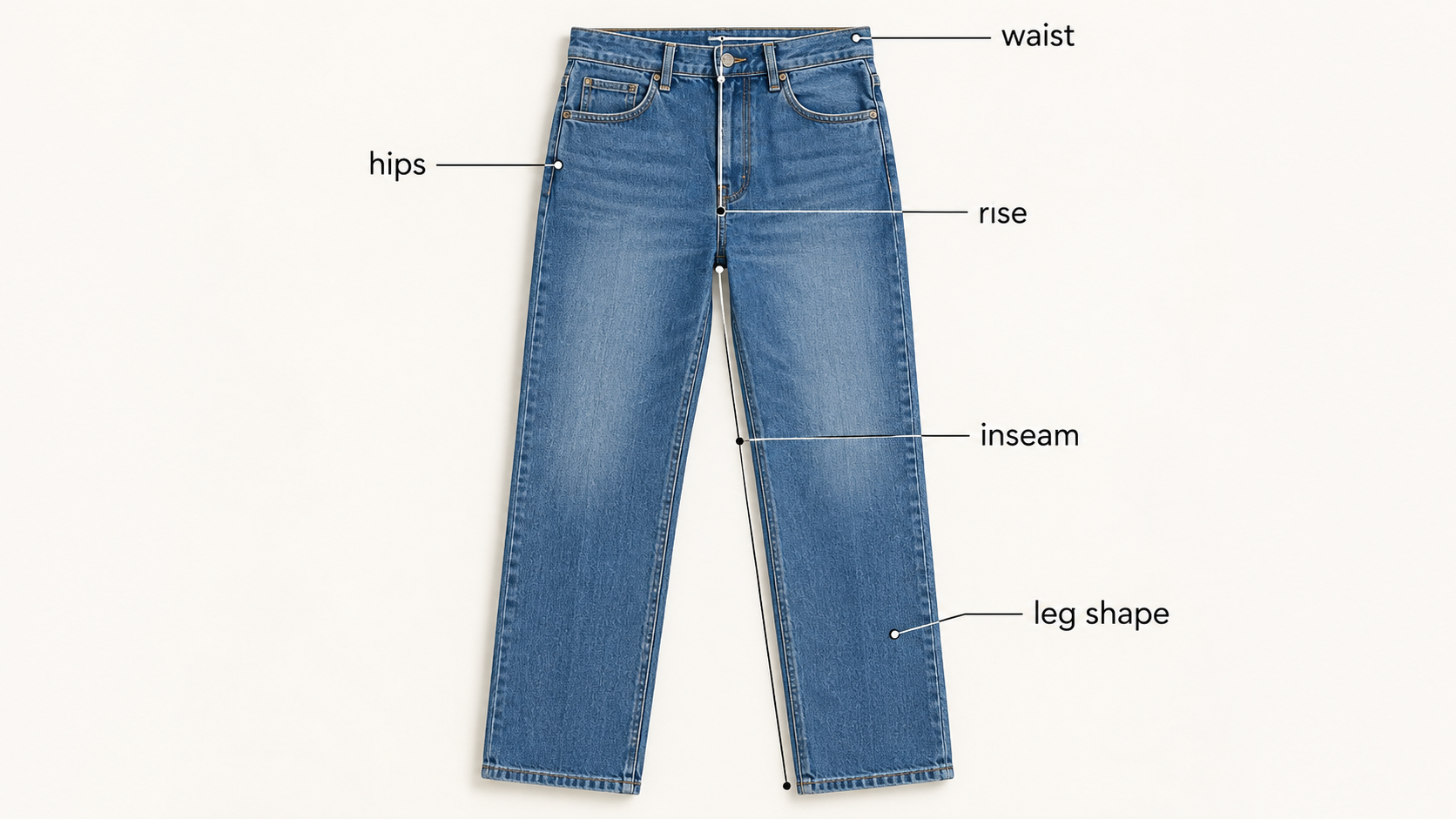
A pair of jeans fits well when several measurements and a design intention line up, not simply when the size on the label matches. Five factors do most of the work: waist, hips, rise (where the waistband sits on your body), inseam (the length of the inner leg) and leg shape (how closely the leg follows your body).
The label on its own is an unreliable guide. Uniqlo's customer service guidance states that its products may fit differently even when they share the same size label, such as XS, S, M, L or XL, because each item is designed with a specific fit, such as regular, slim-fit, relaxed-fit or oversized. Its recommendation is to use the sizing information and tools on each product page, including the product measurements and size chart, rather than relying on the label alone.
This guide is UK-first editorial guidance. It is built from official brand size guides (Uniqlo, Next and White Stuff) and independent editorial context, and it is not based on personal try-on testing. Here is what follows:
- how to measure your waist and hips and read a brand chart;
- what rise and inseam mean and which numbers to check;
- how leg shapes and fit labels change the way a size feels;
- how petite, regular, long and tall lengths work;
- a step-by-step checklist for choosing online.
Measuring Your Waist and Hips
AI-generated generic editorial illustration — not a retailer product photo and does not depict the reviewed product or service. Show readers where to measure waist and hips and how to match those numbers to a brand body-measurement chart.
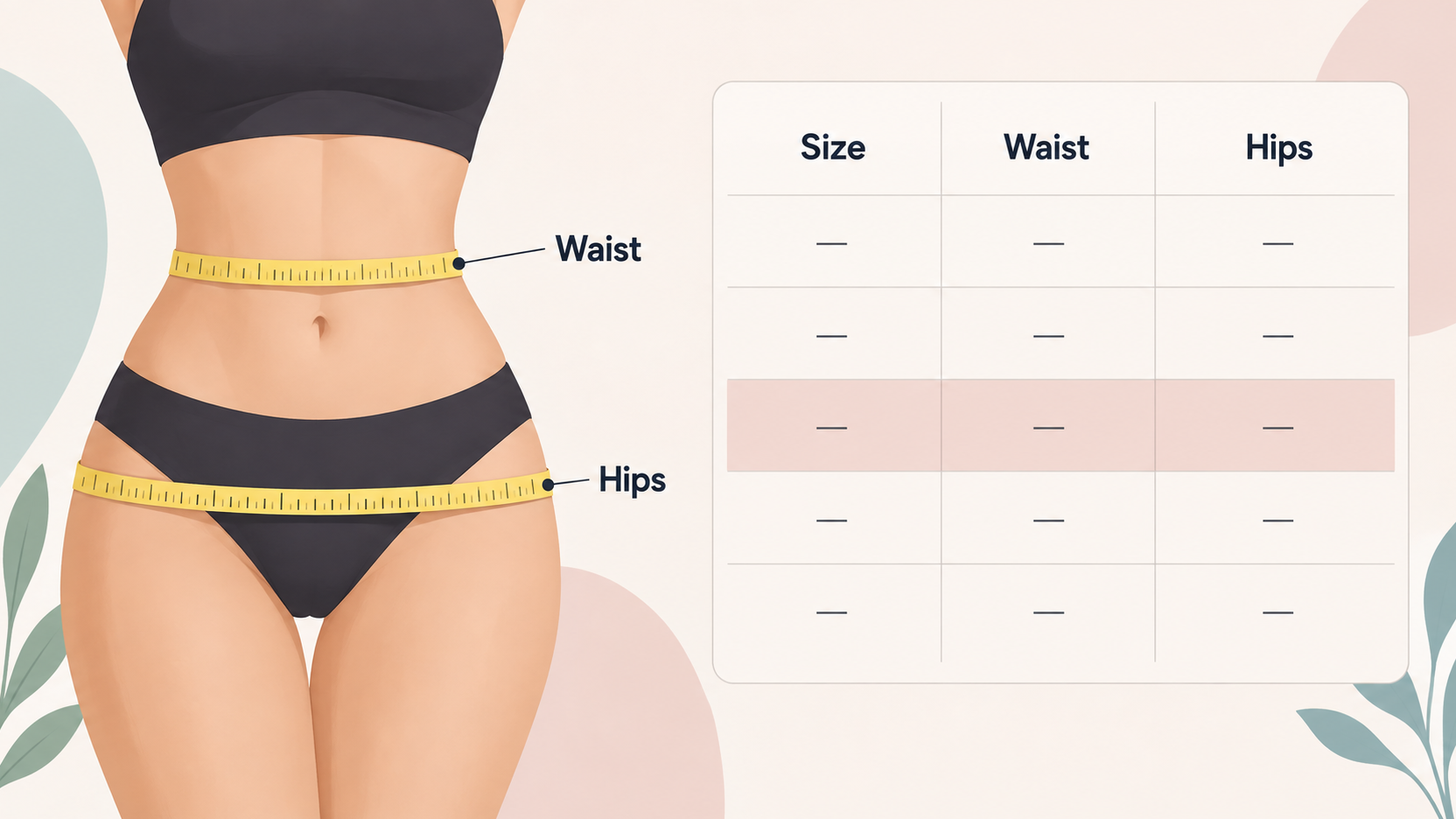
Brands publish body-measurement charts so you can match your own measurements to a size. Next's UK women's sizing guide is a clear example. It gives bust, waist and hip figures in both centimetres and inches, and it invites you to click the (i) icons for instructions on how to measure each area. Measure your body and compare the numbers with the chart, rather than reading a size off a garment you already own. The label in an older pair may come from a different brand or a different cut.
For jeans, the waist and hips are the two body measurements to start with. Here is a worked example from Next's chart (the body measurements are listed under its Tops & Dresses table):
| UK size | Waist | Hips |
|---|---|---|
| 12 | 74 cm (29 in) | 99 cm (39 in) |
| 14 | 79 cm (31 in) | 105.5 cm (41.5 in) |
Waist and hips can fall into different sizes. Someone with a 74 cm waist and 105.5 cm hips would match a UK 12 on the waist but a UK 14 on the hips. When that happens, think about which area the jeans most need to fit. A waistband that gapes or a seat that pulls tight both point to the wrong choice, and the cut you pick (see below) changes how much room you have.
Charts differ from brand to brand, so use the chart published by the brand you are buying from. A UK 12 at one retailer is not guaranteed to match the measurements of a UK 12 at another. Uniqlo, for example, points shoppers to the size chart and product measurements on each product page rather than to a single general table.
Rise, Inseam and Leg Length Explained
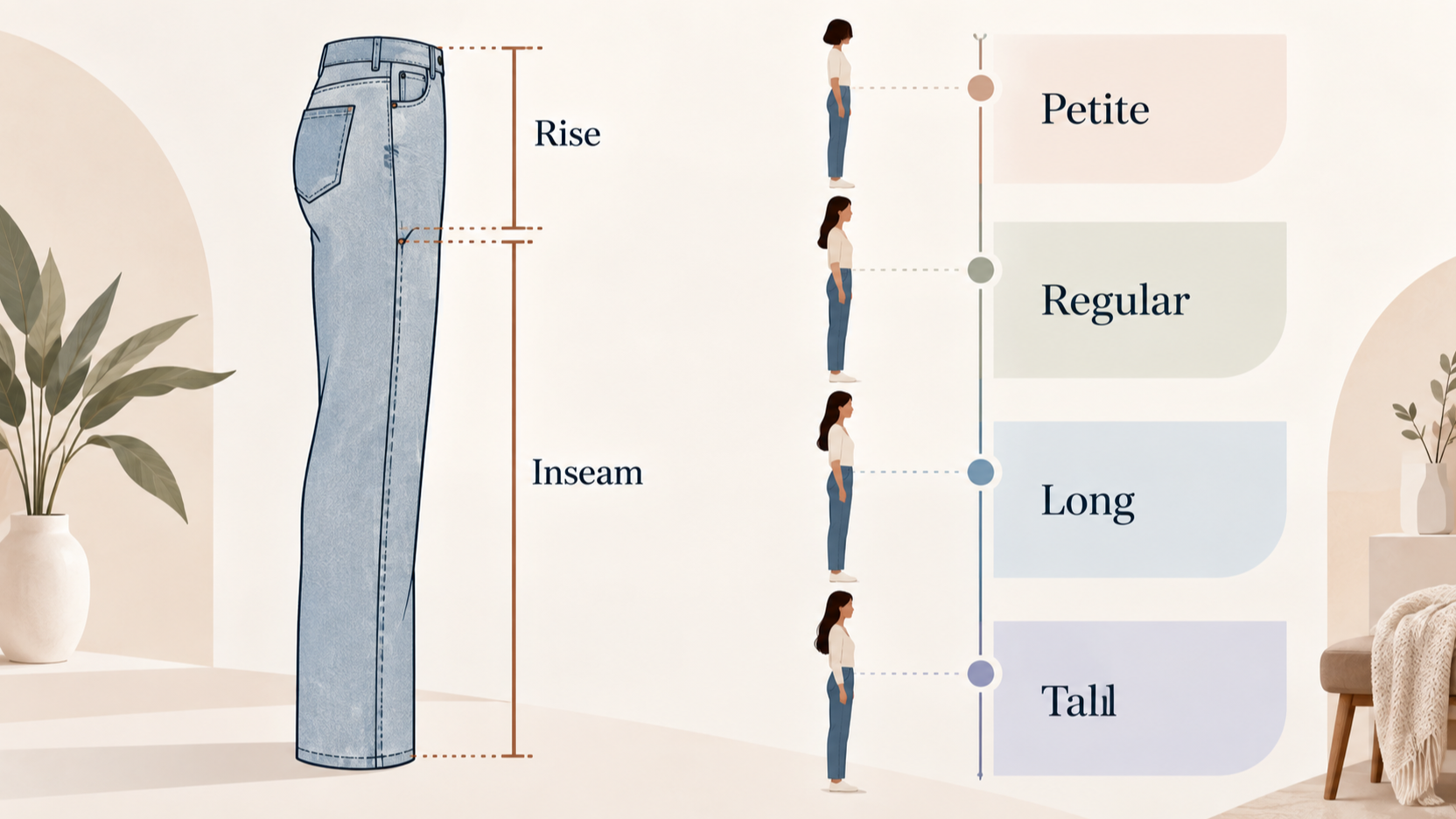
AI-generated generic editorial illustration — not a retailer product photo and does not depict the reviewed product or service. Help readers see how rise sets where jeans sit and how inseam sets where the hem lands for different heights.
Waist size says nothing about two other measurements that shape how jeans feel:
- Rise is the distance from the crotch seam to the top of the waistband. It decides where the waistband sits on your body, whether lower on the hips or closer to the natural waist.
- Inseam is the length of the inner leg, from the crotch seam to the hem. Together with your own proportions, it decides where the hem lands.
Uniqlo notes that garments may sit differently depending on their design. It recommends checking the product measurements and its Height-Based Length Guide to understand where a garment may sit.
Next's Jeans & Trousers guide ties leg length to height bands. For example, its Regular length is for a height of 5'3" to 5'6" (160 to 167.5 cm) and lists a leg-length figure of 74 cm (29 in). The full set of bands is covered in the lengths section below.
Two practical points follow:
- Compare the listed inseam with a pair you already own and like. Lay your favourite pair flat, measure it, and compare it with the product page. This tells you more than the label does, because hem length depends on both the inseam and your own proportions.
- Look for rise in the product details. In the sources used for this guide, rise is not stated in every size chart. Where a brand gives it on the product page, note it, because two pairs with the same waist size can sit at quite different heights.
Leg Shapes and Fits From Slim to Relaxed
Fit labels describe how much room a garment is designed to give. Uniqlo describes distinct fit types, including regular, slim-fit, relaxed-fit and oversized. Its oversized fit is designed to sit loose. The same size label fits differently across these types, so "your size" can change depending on the cut.
In general terms, slimmer cuts follow the body closely, while relaxed and oversized cuts give more room. That has a practical effect on sizing. If you choose a slim cut, accurate waist and hip measurements matter more. With a relaxed cut, you may have more tolerance, but the length and the way the leg falls become more important.
Independent editorial coverage points the same way on range. A Who What Wear round-up by fashion editor Florrie Alexander says the high street now offers an influx of styles, lengths and shapes. The editor also observes that the pairs they rated most highly tend to be classic designs, without embellishments or gimmicks. This is one editor's view, not a test we have carried out, and it should be read as context rather than a ranking.
The same editor says that size ranges, materials and fastenings were all part of the assessment. You can apply that thinking when you shop. Check the fabric composition on the product page, and be aware that fabric and fastenings can change how a pair feels even when the cut and size are the same. If you are unsure how much give a fabric has, read the brand's fit notes rather than assuming.
Petite, Regular, Long and Tall Lengths
Many brands offer length options tied to height. Next's Jeans & Trousers guide gives these bands:
| Length | Height | Leg length |
|---|---|---|
| Petite | 4'11" to 5'3" (150 to 160 cm) | 69 cm (27.5 in) |
| Regular | 5'3" to 5'6" (160 to 167.5 cm) | 74 cm (29 in) |
| Long | 5'6" to 5'10" (167.5 to 177.5 cm) | 79 cm (31 in) |
| Extra Long | 5'10" and over (177.5 cm+) | 84 cm (33 in) |
| Tall | 5'10" and over (177.5 cm+) | 89 cm (35 in) |
Note that Extra Long and Tall are both listed for heights of 5'10" and over, with different lengths, so check the product page to see which option the brand offers for that style.
Uniqlo takes a similar approach with a Fit Guide by Height and a Height-Based Length Guide, which show where a garment may sit on your body.
Height bands are a starting point, not a rule. Your leg proportions and the hem you want matter too. A full-length hem, a cropped finish and a stacked hem each call for a different length. If you are between bands, compare the listed leg length with a pair you already own.
On range, the Who What Wear editor highlights Zara's petite-friendly styles and Abercrombie & Fitch's Curve Love range as examples of the high street catering for different body types and heights. We have not assessed those ranges ourselves, and this guide does not make claims about brands whose size information is not covered by the sources used here.
What Brand Size Guides Do Well
Official size guides are the primary source for sizing, and they have clear strengths:
- Concrete numbers. Next publishes body measurements in centimetres and inches, so you can match figures rather than guess.
- Height-based guidance. Next links length options to height bands, and Uniqlo offers a Fit Guide by Height and a Height-Based Length Guide.
- Tools on the product page. Uniqlo points shoppers to MySize ASSIST, product measurements, size charts, a compare-sizes option, StyleHint and customer content.
- Instructions for measuring. Next explains how to measure each area through its (i) icons.
- Dedicated denim pages. White Stuff publishes a Denim Fit Guide page for its denim range.
Independent editorial context adds a different kind of scrutiny. The Who What Wear editor looked at size range, materials and fastenings. That is an editor's assessment, not our testing, but it flags the same factors worth checking in any product listing.
Where Size Guides and Labels Fall Short
Size guides are useful, but they have limits, and it helps to know where to double-check.
- Labels are not consistent. Uniqlo itself says that items sharing a size label may fit differently, because each is designed with its own fit. That applies across fits within one brand, and the same caution applies between brands.
- Charts are brand-specific. A size in one retailer does not transfer automatically to another, because each brand publishes its own chart.
- Body charts cannot capture everything. A chart of body measurements does not tell you how much a fabric stretches, how it behaves when worn or how snug you like your jeans.
- Gaps in this guide's evidence. This guide is editorial and built from official guides and independent context. It is not based on try-on testing. The sources used do not cover every brand (there is no Sweaty Betty data, for example), and the White Stuff source gave limited detail beyond its Denim Fit Guide page. Always read each brand's current guide before you order.
Because of these limits, check the return and exchange policy before you buy. Next's help centre, for example, has a dedicated article on what to do if an item does not fit.
How to Choose Your Jeans Size Step by Step
AI-generated generic editorial illustration — not a retailer product photo and does not depict the reviewed product or service. Turn the guide into a visual first-time-online decision flow covering size, rise, length and cut.
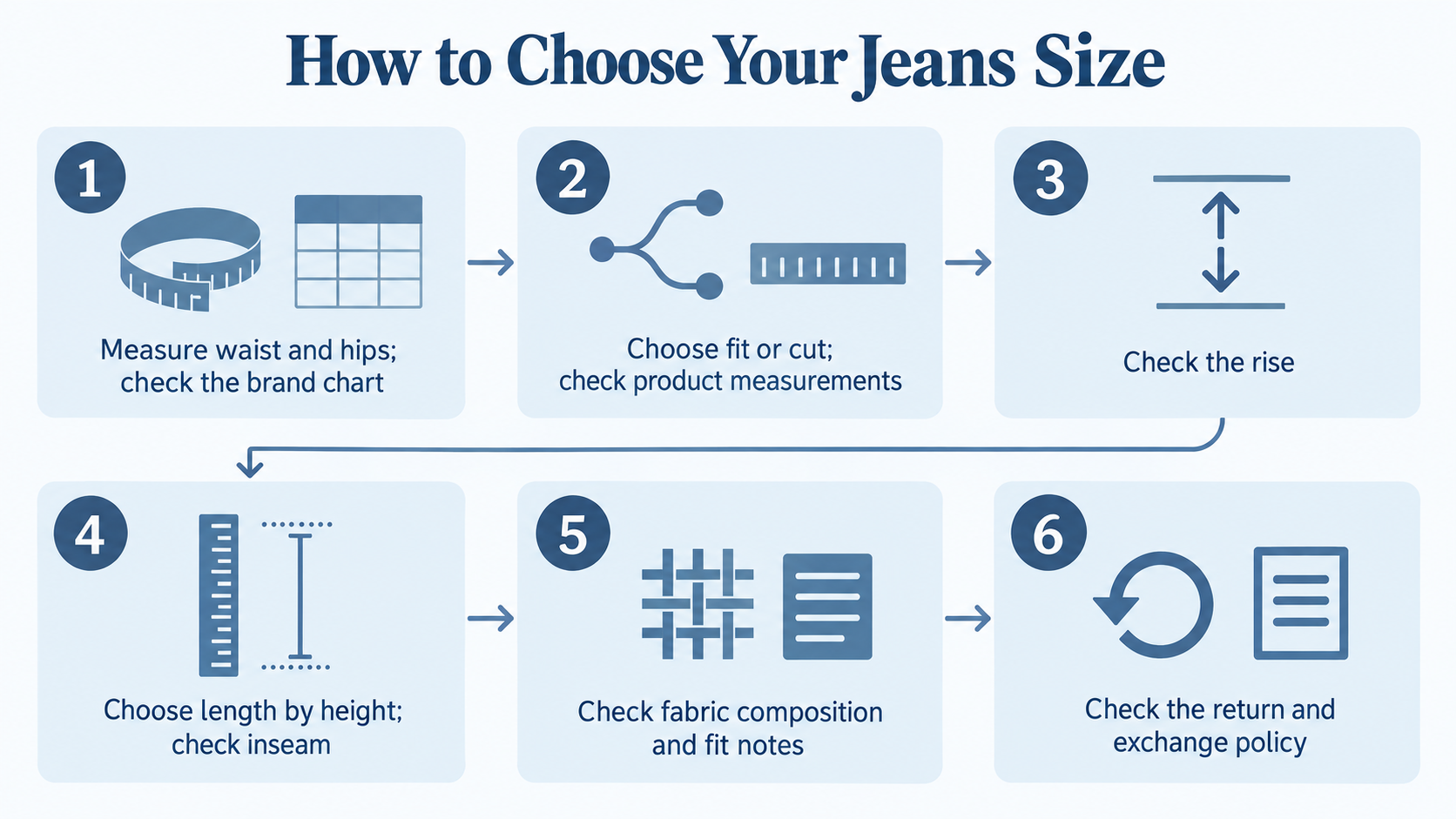
Use this order when you are buying jeans online for the first time:
- Measure your waist and hips and compare them with the brand's own chart. Use the (i) style instructions if the brand gives them, as Next does.
- Choose the fit or cut (slim, regular, relaxed or oversized) and read the product measurements. The same size label fits differently across cuts.
- Check the rise in the product details where the brand gives it, so you know where the waistband will sit.
- Pick the length option for your height and check the listed inseam against the brand's height guide. Compare it with a pair you already own if you are between lengths.
- Check the fabric composition and any fit notes the brand provides, because fabric and fastenings affect how a pair feels.
- Check the return and exchange policy before ordering. If your size is borderline, compare the product measurements with a pair that fits you well.
Where a brand offers tools, use them. Uniqlo, for instance, provides MySize ASSIST and a compare-sizes feature on its product pages, alongside StyleHint and customer content.
Frequently Asked Questions
Why do jeans in the same size fit differently between styles and brands?
Each style is designed with a particular fit in mind. Uniqlo states that products can fit differently even when they share a size label, because each item has a specific fit, such as regular, slim-fit, relaxed-fit or oversized. Brands also publish their own charts, so the same number can mean different measurements at different retailers.
How do I know whether I need petite, regular or long jeans?
Start with your height and the brand's length guide. Next's guide lists Petite for 4'11" to 5'3" (150 to 160 cm), Regular for 5'3" to 5'6" (160 to 167.5 cm) and Long for 5'6" to 5'10" (167.5 to 177.5 cm), with Extra Long and Tall for 5'10" and over. Then check the listed inseam on the product page and compare it with a pair you own, since proportions and your preferred hem length also matter.
Should I choose jeans by waist measurement or hip measurement?
Check both against the brand's chart. They can fall into different sizes: in Next's chart, a 74 cm waist matches a UK 12, while 105.5 cm hips match a UK 14. Prioritise the area the cut most needs to fit. Then use the product measurements and fit notes to judge how the jeans will sit.
What is the difference between rise and inseam, and which matters more for fit?
Rise is the distance from the crotch seam to the waistband, so it sets where the jeans sit on your body. Inseam is the inner-leg length, so it sets where the hem lands. Neither matters more in every case. Rise affects comfort and where the waistband sits, and inseam affects the hem. Check both in the product details where they are given, as rise is not listed in every size chart.
Can I rely on a UK size chart from one brand when buying from another?
No. Each brand publishes its own chart, and even within one brand the fit type changes how a size feels. Use the chart and product measurements from the brand you are buying from. If you are unsure, compare the listed measurements with a pair you already own and like.
Sources
Related reading
- Best high-street jeans for petite, regular and tall leg lengths: evidence-led top choices
- How to choose your clothing size online: measuring yourself and converting US, UK and EU sizes
- White Stuff sizing review: practical fit assessment for jeans and petite ranges
- Uniqlo vs Next sizing: which high-street brand fits better for everyday basics
Editorial information: About our editorial team · Read our editorial policy · Read our affiliate disclosure.