Why the Same Size Label Fits Differently Online
AI-generated generic editorial illustration — not a retailer product photo and does not depict the reviewed product or service. Editorial illustration supporting this section.
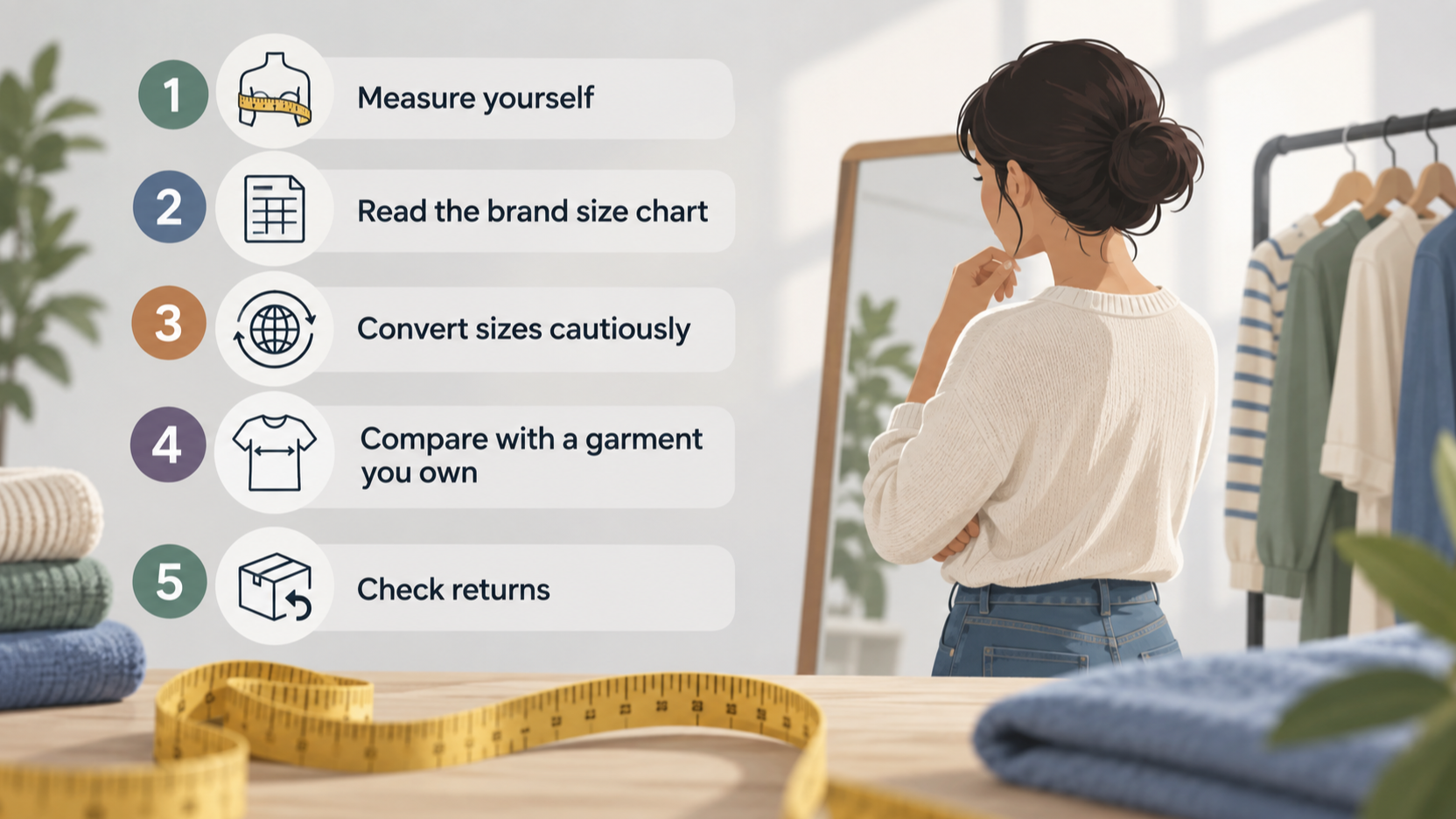
A size label on its own is a weak guide when you buy clothes online. The dependable route has five steps:
- Measure yourself (bust, waist, hips and height).
- Read the brand's chart for the specific garment type.
- Convert sizes carefully, using the retailer's own table where there is one.
- Compare with a garment you own that already fits well.
- Check the returns terms before you order.
The reason is that a label is not a fixed measurement. Uniqlo's help centre states that its products may fit differently even when they share the same label, such as XS, S, M, L or XL, because each item is designed with a specific fit: regular, slim-fit, relaxed-fit or oversized. So the same label can behave differently within a single brand.
Between brands, the picture is similar. A 2017 Marie Claire feature explains that standardised ready-to-wear sizing dates from the 1930s and that most sizing charts are based on only two or three body dimensions. It also notes that you can end up a different size in different shops. That piece is dated editorial commentary rather than a measurement study, but it helps explain why one label cannot be trusted everywhere.
This guide is editorial guidance drawn from official size guides and independent commentary. It is not based on hands-on try-on testing.
How to Measure Yourself Before You Order
AI-generated generic editorial illustration — not a retailer product photo and does not depict the reviewed product or service. Show the body points to measure and record before matching to a brand chart.
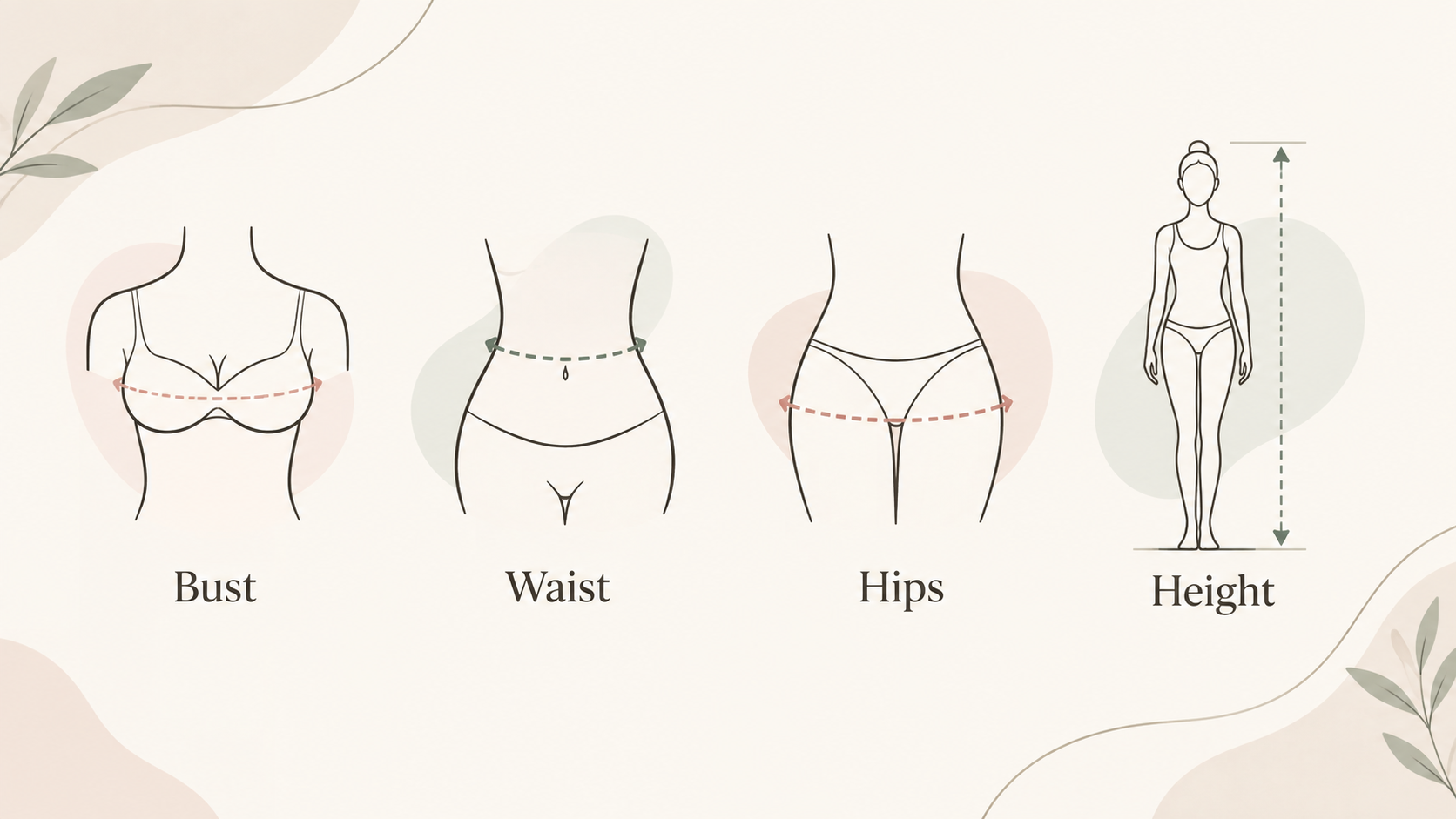
Start with your own body rather than the number on a label you usually buy. Next's women's sizing guide asks shoppers to measure their body and then match the figures to a chart. Its chart columns are bust, waist and hips, shown in both centimetres and inches. The guide also has (i) icons that explain how to measure each area, so use a retailer's own measuring instructions wherever it provides them. Sweaty Betty's size guide includes a "How to measure" link for the same purpose.
Which measurements you need depends on the garment:
- Bust, waist and hips for tops, dresses and general clothing. Sweaty Betty's general chart uses all three.
- Waist and hips for activewear bottoms. Sweaty Betty's leggings and trousers charts use these two.
- Height for trouser and jeans length. Next's jeans and trousers guide links its length options to height bands, and Uniqlo offers a Height-Based Length Guide.
A few habits help, though they are general good practice rather than something taken from a single brand's guide:
- Measure twice and check the figures match.
- Record the results in both centimetres and inches, since charts differ.
- Measure over underwear or light clothing, and keep the tape snug but not tight.
- Write the numbers down so you can compare them with any chart.
Reading a Brand Size Chart Correctly
AI-generated generic editorial illustration — not a retailer product photo and does not depict the reviewed product or service. Summarise the points for reading a brand size chart correctly.
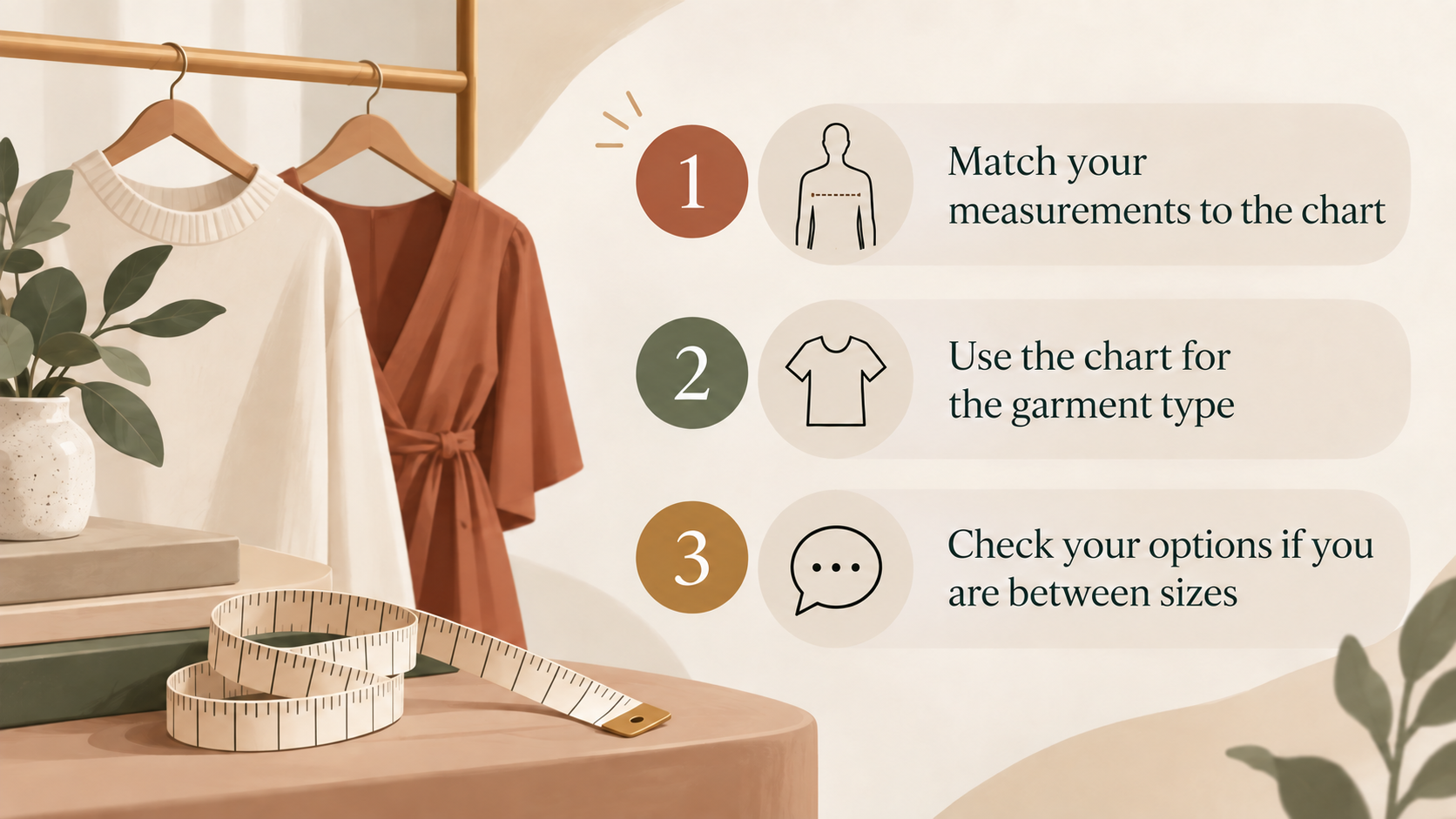
Brands publish separate charts for different garment types, so first make sure you are looking at the right one. Next has separate Tops & Dresses and Jeans & Trousers charts. Sweaty Betty has Leggings, Trousers, General, Bras and Shoes charts.
Then match your measurements to the row or column on that chart. Two worked examples show how this looks in practice:
- Next, tops and dresses: a UK 12 lists a bust of 90 cm, a waist of 74 cm and hips of 99 cm.
- Sweaty Betty, leggings: UK 10 / S lists a waist of 69 cm and hips of 96 cm. Note that the chart pairs UK numeric sizes with letter sizes, so you can see both at once.
If your measurements sit between two sizes, look for the brand's own guidance rather than guessing. Sweaty Betty, for example, has a dedicated "Between sizes" section. Uniqlo recommends using the measurements and size chart on the product page together with its Compare Product Sizes tool, and says its MySize ASSIST tool is available to help.
One more check: see whether the chart gives body measurements or garment measurements. They are not the same thing, and mixing them up is an easy way to pick the wrong size.
Converting Between UK, EU and US Sizes
Conversion is where guesswork causes most mistakes, so rely on a retailer's own table. Shoes are the clearest case in the evidence we reviewed. Next's women's footwear table (the slippers table in the guide we reviewed) lists UK, EU, US and AU/NZ sizes side by side, for example UK 3 = EU 35.5 = US 5 and UK 4 = EU 37 = US 6.
The same table also gives foot length in centimetres, such as 22.9 cm for a UK 4 in standard fit. That makes foot length the safest check for shoes: if a conversion looks doubtful, compare it with a measurement of your foot.
For clothing, there is no single universal UK-to-US-to-EU rule that the sources we reviewed support. Conversions vary by brand and by garment. A few ways to stay safe:
- Look for the retailer's own conversion table. Sweaty Betty's size guide, for instance, has an International Conversions section.
- If a brand has no table, convert through your body measurements in centimetres rather than moving from one label to another.
- Treat any generic conversion you find elsewhere as a starting point only.
How Uniqlo, Next, White Stuff and Sweaty Betty Size Their Ranges
Each of these four brands publishes its own official guidance, and they differ in what they offer. Here is what each one shows and what to check first.
Uniqlo. Fit varies by design (regular, slim, relaxed, oversized). Its help centre points to MySize ASSIST, the size chart, Compare Product Sizes and a Height-Based Length Guide. Check first: the fit type and the product page's measurements.
Next. It has separate guides for women's tops and dresses (UK 4 to 26), jeans and trousers by height band, and footwear, plus separate men's, homeware, brand and pets guides. Check first: that you are on the right table for the garment.
White Stuff. It publishes a size guide page, and its navigation shows petite and tall ranges (such as petite dresses and tall men's clothing) as well as wide-fit women's shoes. The excerpt we reviewed gave no measurement values, so open the live guide to see the figures. Check first: the live chart for your garment type.
Sweaty Betty. Its UK sizes run from 6 / XXS to 18-20 / XXL, with alpha and numeric sizes paired. Leggings and trousers have inseam options, and it suggests those who are 5'4" or under try the Short length. Check first: the inseam and the waist and hip rows.
The approaches differ, with height-based length guidance at Uniqlo and Next, garment-specific fit labels at Uniqlo, and paired alpha and numeric sizing at Sweaty Betty, but none of them replaces checking the specific product you want.
Petite, Tall and Plus: Length and Range Options
If you sit outside standard lengths, look at the length options first. Next's jeans and trousers guide gives height bands: Petite (4'11" to 5'3"), Regular (5'3" to 5'6"), Long (5'6" to 5'10"), and Extra Long and Tall (5'10" and over). Its listed lengths run from 69 cm to 89 cm, so a Petite option is listed at 69 cm while a Tall option is listed at 89 cm.
Sweaty Betty offers Short and Regular inseams on selected trousers and suggests Short for those 5'4" or under. White Stuff's navigation lists petite dresses and a Tall men's clothing category, and shows wide-fit women's shoes by size.
Range limits also differ by brand. Next's women's tops and dresses chart runs from UK 4 to 26, while Sweaty Betty's general chart runs to UK 18-20 / XXL. Check the range before you start shopping, so you are not measuring for a brand that does not offer your size.
The sources we reviewed do not cover each brand's dedicated plus-size policy, so check the live range pages for current options.
Comparing With a Garment You Already Own
AI-generated generic editorial illustration — not a retailer product photo and does not depict the reviewed product or service. Illustrate the garment-comparison method as a simple sequence of steps.
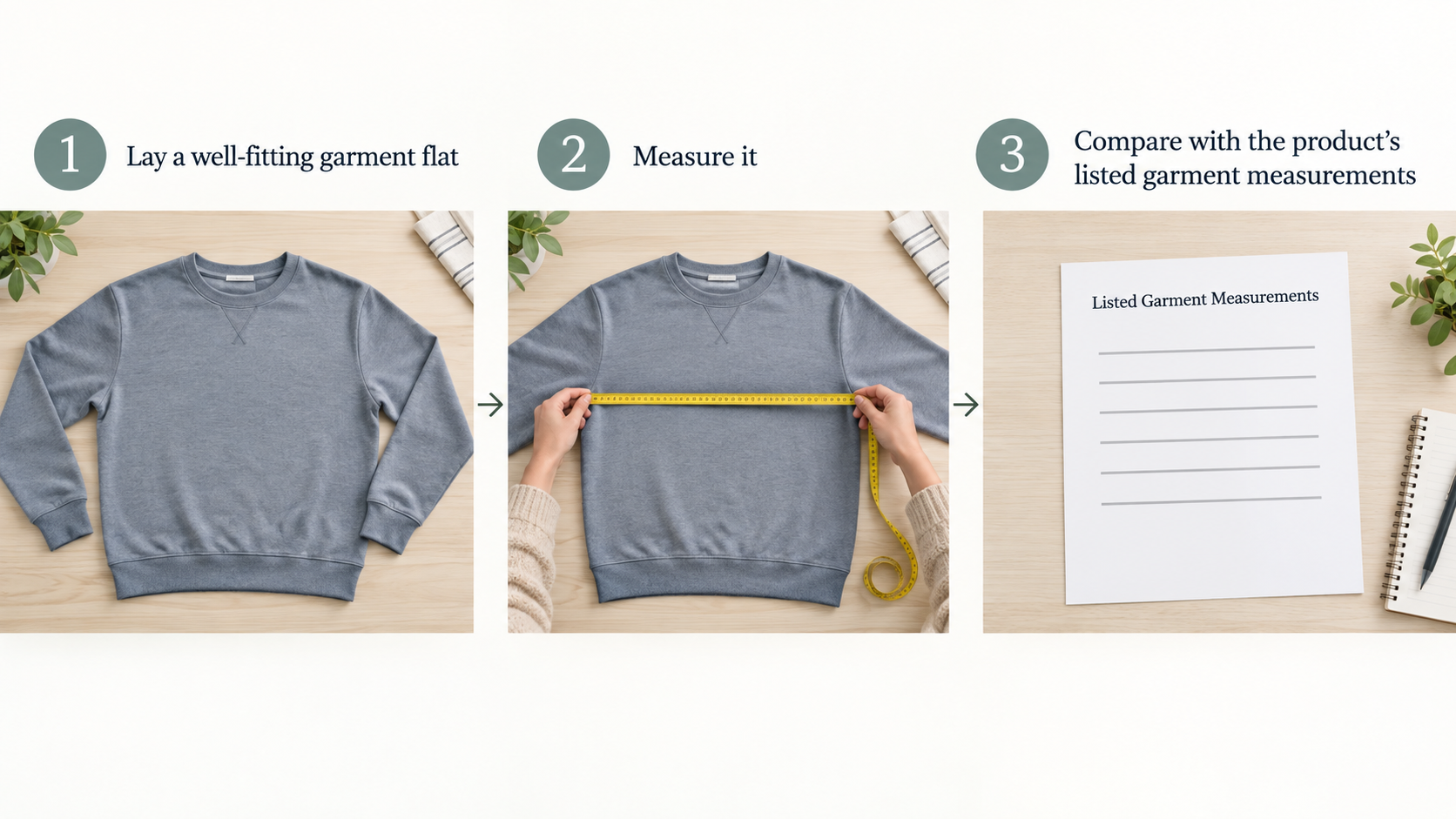
If you have an item that fits well, it can be a useful reference. Uniqlo lists "Compare Product Sizes" and "Check the Product Details" among its recommended steps, which supports the idea of comparing garment dimensions.
- Lay the item flat on a table or bed and smooth it out.
- Measure it: chest, waist, hip and length, as relevant to the garment.
- Compare your figures with the garment measurements listed for the product you want.
Two cautions apply. First, garment measurements are different from body measurements, so allow for the intended fit. A fitted style and an oversized style will list very different dimensions for the same person. Second, compare like with like: jeans with jeans, a knit with a knit, a dress with a dress. A reference garment from another category tells you little.
What Size Charts Do Well
Official charts have real strengths when you use them properly:
- They give concrete numbers. Next and Sweaty Betty publish body measurements in centimetres and inches, which are more objective than a letter or number on a label.
- They are specific. Brands separate charts by garment type and add length options by height, which makes the match more precise.
- They come with extra tools. Examples include Uniqlo's MySize ASSIST and compare function, Next's measuring icons and Sweaty Betty's between-sizes advice.
- They avoid generic conversion. Using the brand's own chart means you are not relying on a rule of thumb that may not apply.
Where Size Charts Fall Short
Charts simplify bodies. The 2017 Marie Claire piece argues that standard charts rely on two or three dimensions and may not reflect varied body shapes. Treat that as dated editorial context rather than a measurement study.
A chart also does not remove the need to check the specific product, because Uniqlo says the same label can fit differently by design.
Information can be out of date or incomplete. The White Stuff excerpt we reviewed showed no figures, and charts can change. The figures quoted in this guide reflect the cited pages as we reviewed them, so always check the live page before you order.
Finally, no chart replaces trying a garment on, and this guide is editorial rather than based on hands-on testing. Sizing is a matter of clothing fit, so avoid drawing conclusions about your health or body from a label.
Check Returns Before You Buy
Since no chart is perfect, confirm the returns terms before you commit to a size. The retailers we reviewed each point to this information:
- Next has a help article titled "What if the item does not fit?"
- Uniqlo's help centre has a Return & Exchange section covering conditions and refund timeframes.
- Sweaty Betty's size guide includes a Returns link.
- White Stuff's page states that it has extended its returns policy until 10/01/27. That is the date format shown on the page, so confirm the exact end date and terms with the retailer.
The excerpts we reviewed do not spell out the terms, so open the live pages. Before ordering a close-fit size, check the returns window, who pays for return postage, any condition requirements and whether exchanges are offered. Where the policy allows, ordering a backup size can be a sensible option.
Details of your statutory consumer rights are outside the sources used here, so consult official UK consumer guidance rather than relying on this article.
Frequently Asked Questions
What should I do if my measurements fall between two sizes?
Look for the brand's own between-sizes advice rather than guessing. Sweaty Betty, for example, has a "Between sizes" section. Also consider the intended fit of the garment, since a relaxed or oversized item behaves differently from a slim one, and check the product's garment measurements. Confirm the returns terms before ordering.
Is a UK size the same number as a US or EU size?
No, and conversions vary by brand and garment. Use the retailer's own table where there is one. Next's footwear table, for instance, shows UK 3 = EU 35.5 = US 5 and UK 4 = EU 37 = US 6, and also lists foot length. Where there is no table, convert through your body measurements in centimetres.
How do I choose the right length for jeans and trousers?
Start with your height. Next's jeans and trousers guide ties length options to height bands, from Petite (4'11" to 5'3") to Extra Long and Tall (5'10" and over). Sweaty Betty offers Short and Regular inseams on selected trousers and suggests Short for those 5'4" or under. Uniqlo has a Height-Based Length Guide.
Will I be the same size in every brand?
Not necessarily. Uniqlo says items sharing a label can fit differently because each is designed with a specific fit, and a 2017 Marie Claire feature notes that sizing charts differ and you can be a different size in different shops. Rely on your measurements and each brand's own chart instead of your usual label.
Sources
Related reading
- How jeans should fit: waist, rise, inseam and leg shape explained
- Uniqlo sizing review: how it fits, size conversion and alternatives
- Next sizing review: who its size ranges suit and who should size differently
- Sweaty Betty sizing review: leggings and sports bra fit assessment
Editorial information: About our editorial team · Read our editorial policy · Read our affiliate disclosure.