How to Tell Whether a Clothing Discount Is Genuine
AI-generated generic editorial illustration — not a retailer product photo and does not depict the reviewed product or service. Editorial illustration supporting this section.
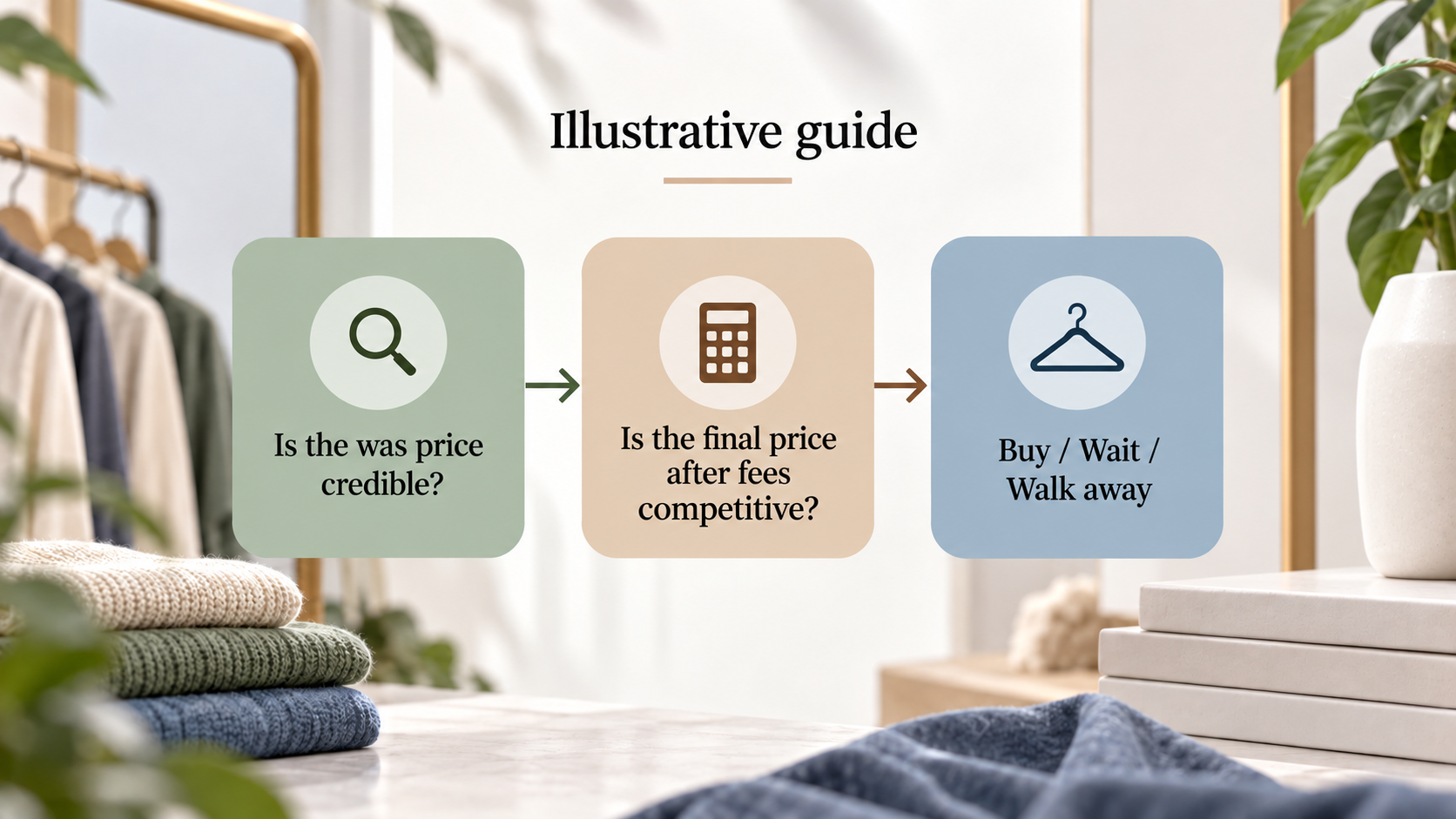
A clothing discount is genuine when two things are true. The price it is measured against must be credible, and the final price you pay, including any extra fees, must be competitive with what comparable sellers charge. A big percentage-off label proves neither.
UK government price-marking guidance sets out the problem. Shoppers can only make informed choices when pricing information is clear and transparent. Yet when they face a variety of prices, promotions, loyalty discount offers and reductions, it can be hard to make like-for-like comparisons. Which? adds a sobering data point. It looked at 175 Black Friday deals on popular products and found that genuinely good deals are very rare. That research covered popular products rather than clothing specifically, but the lesson carries over: a headline saving is not proof of value.
This guide takes the checks in order:
- what UK rules and regulators do for you, and where they stop
- how to read a was/now price
- how to spot checkout fees and pressure
- how to compare retailers and price history
- when waiting beats buying
- a pre-purchase checklist
It summarises official and independent sources. It is source-based editorial guidance, not hands-on testing of any retailer's pricing.
What UK Price Rules Do for Clothing Shoppers
The Price Marking Order 2004 (PMO 2004) is the main rule governing how retailers display prices to consumers in England, Scotland and Wales. It implemented an EU directive, Directive 98/6/EC, and came into force on 22 July 2004. It has since been amended, most recently by the Price Marking (Amendment) Order 2024 and the Price Marking (Amendment) Order 2025. Both sets of amendments took effect on 6 April 2026, so the amended rules now apply.
The order covers goods, not services. Clothing and footwear are goods, so the order applies to the prices you see on a clothing website or shop rail.
A second layer of protection comes from the Competition and Markets Authority (CMA). Under the Digital Markets, Competition and Consumers Act 2024 (DMCCA), the CMA now has direct consumer protection powers. In November 2025 it announced a package of action on online pricing practices, including drip pricing and pressure selling. It said that drip pricing and misleading countdown timers are banned under the new regime.
The CMA also published finalised guidance for businesses to help them comply with the law. That guidance is written for retailers, but it gives shoppers a useful benchmark for what fair online pricing should look like.
Where the Rules and Your Protection Run Out
The rules set a floor, not a guarantee of a bargain. Four limits matter.
Enforcement is selective. The CMA has said it will focus early enforcement action on the most egregious practices that are harmful to consumers. That means not every misleading price will be pursued.
Clothing is not obviously the target. The CMA's first investigations and advisory letters span 14 sectors. The businesses named in its announcement are ticketing, driving schools, a gym chain, and online sellers of furniture and appliances. None of them is a clothing retailer. Do not assume clothing pricing is being policed specifically, even though the same rules apply to it.
Legal does not mean good value. The rules govern how prices are shown, not whether a retailer's price is competitive. A promotion can be presented lawfully and still be dearer than the same item elsewhere. Which? found that genuinely good deals are rare even at high-profile sale events, so a legal promotion is not necessarily a bargain.
The evidence has gaps. The sources behind this guide do not establish the pricing history of any particular retailer or product. Check the item you are considering yourself, using the methods below, rather than assuming a given shop's sale is honest or dishonest.
How Was/Now and Reference Prices Work
AI-generated generic editorial illustration — not a retailer product photo and does not depict the reviewed product or service. Walk readers through the questions to ask about a was/now claim and its reference price.
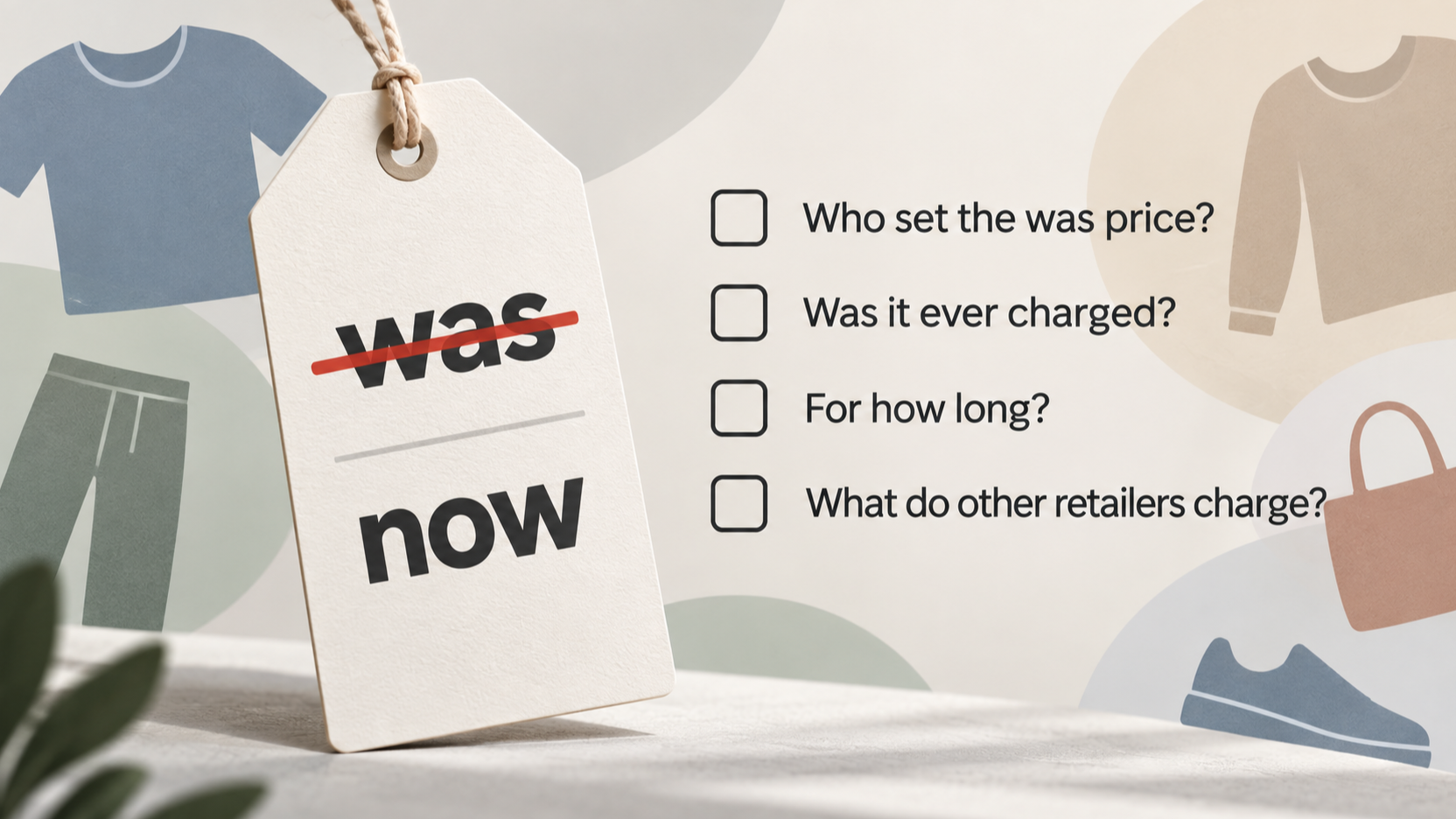
A was/now claim shows a higher "was" price crossed out beside a lower "now" price. The "was" price is the reference price, and every percentage-off figure depends on it. Which? advises shoppers not to be duped by a "was" price. The claim only means something if the item was genuinely sold at that price. A saving measured against a price nobody really paid is just a number.
This is why price-marking guidance exists. It aims to let consumers make like-for-like comparisons despite the variety of promotions and reductions on offer. A reference price can flatter a discount, so the final price you pay matters more than the headline saving.
Before trusting a was/now claim, ask:
- Who set the "was" price? Is it the retailer's own earlier price, a rival retailer's price or a recommended retail price (RRP)?
- How long was the item at the higher price? A brief spell at a high price is a weaker reference than a long one.
- Was it ever charged? Look for evidence that real sales happened at that level.
- Is the item sold elsewhere at the "now" price or lower? If so, the saving is less impressive than it looks.
Neither the government guidance nor the Which? advice supplies a rule for how long a "was" price should have applied. Treat these as questions to investigate, not legal tests. The next sections show how to check them.
Drip Pricing, Countdown Timers and Pressure Tactics
AI-generated generic editorial illustration — not a retailer product photo and does not depict the reviewed product or service. Help readers spot late-added fees, countdown timers and pressure tactics during online checkout.
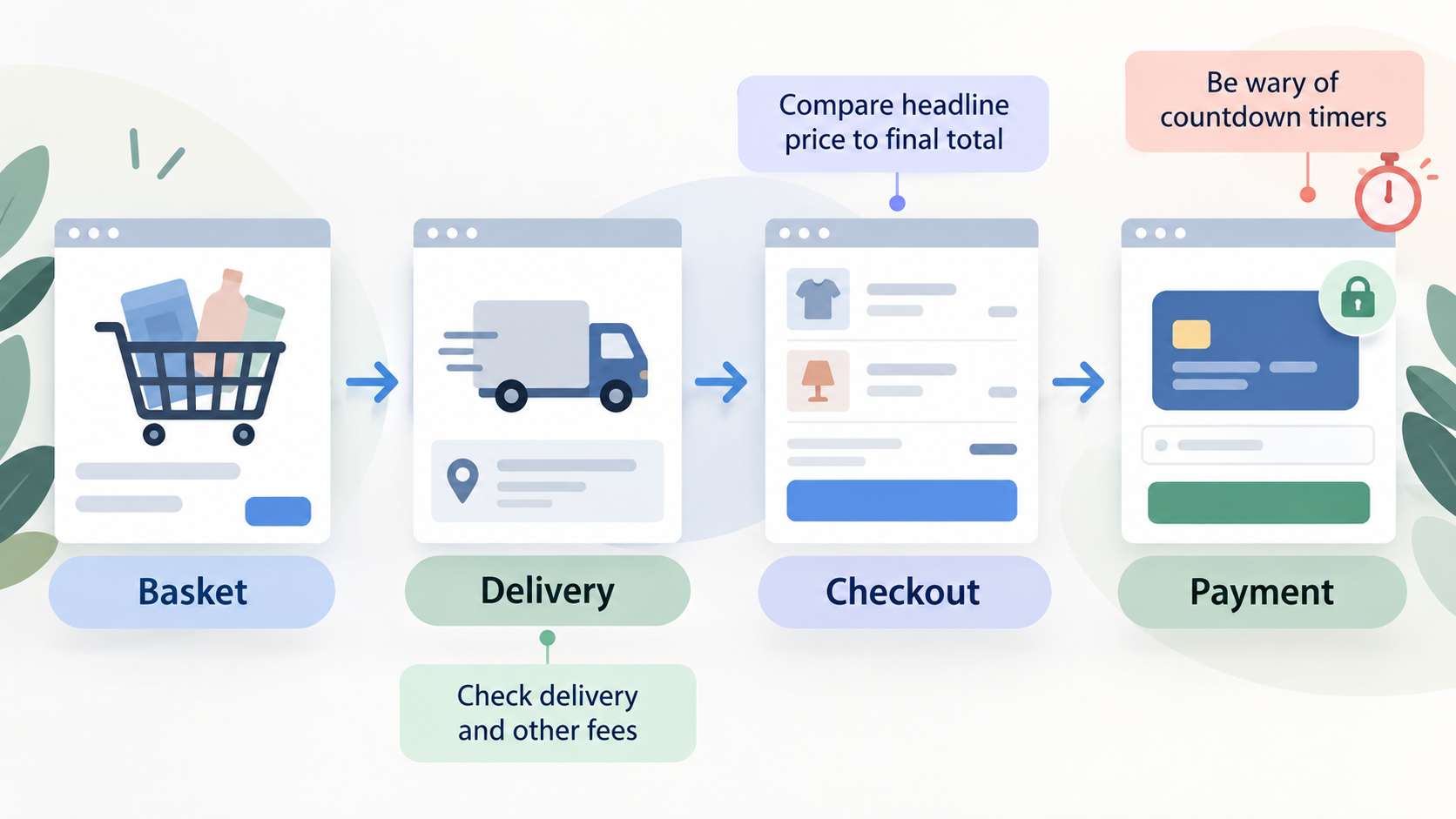
Even a real saving can be eroded at checkout. Drip pricing is when extra fees appear after the headline price has drawn you in. The CMA is targeting it, and it has said that misleading countdown timers are banned under the new regime. When it announced its drive on online pricing practices, it also wrote to 100 businesses across 14 sectors about their use of additional fees and sales tactics.
For clothing, the practical response is simple. Compare the total at the end of checkout, not the listed price. Include delivery and any charge for returns, because a cheaper item with a paid delivery or returns charge can cost more than a dearer one with neither. For more on what to expect if an item does not fit, see our guide to returns and refunds when buying clothes online.
On urgency, Which? research suggests there is usually no need to rush for "one day only" deals, because genuinely good deals are rare. A ticking clock is a reason to slow down and check, not to hurry. If a timer pushes you to pay before you have compared prices, the saving is probably not as large as the page implies. If it looks misleading, the CMA's position is that misleading timers are banned, so it is worth recording what you saw.
Comparing Prices Across Retailers and Price History
AI-generated generic editorial illustration — not a retailer product photo and does not depict the reviewed product or service. Show a practical method for comparing the same clothing item across retailers and over time.
The most reliable test of a deal is whether anyone else sells the same item for less. Which? points to price comparison sites such as Google Shopping, PriceRunner and PriceSpy. These check prices, including delivery charges, across multiple websites. Searches can be very specific, with exact brand, model and colour, or looser at the start of a buying journey when you only want a rough idea of prices.
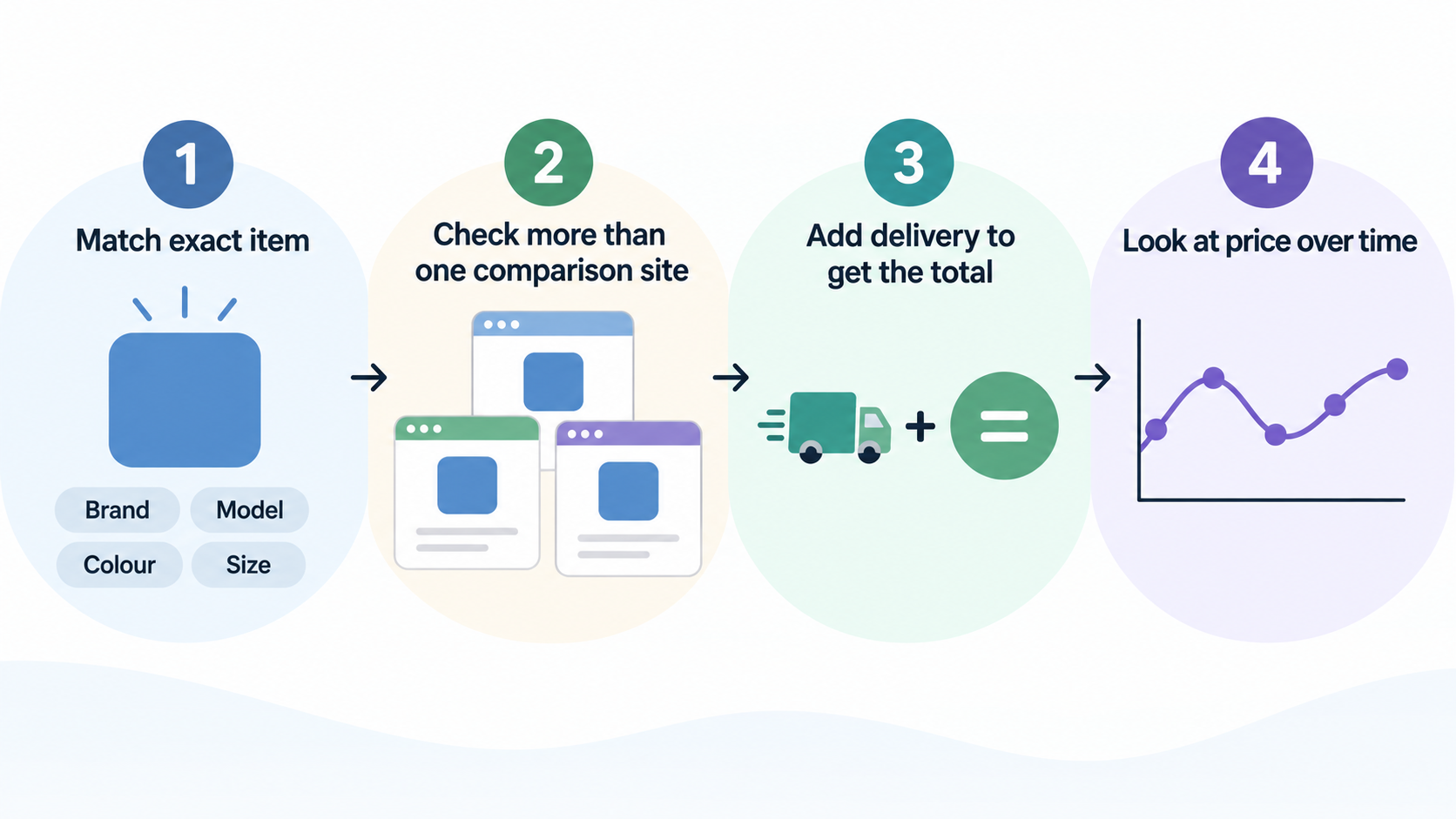
A workable method has four steps:
- Match the exact item. Compare brand, model, colour and size. A similar-looking item at another retailer is not a like-for-like comparison. Sizes and fits vary between brands, so use our clothing size conversion and sizing guides to make sure you are comparing the right size.
- Check more than one comparison site. Previous Which? research found that comparison sites sometimes display different prices for the same items at the same retailers.
- Add delivery to get the total. Compare what you would actually pay.
- Look at price over time. Price history tools can show whether a reduction is real, but use them alongside a current-price comparison, not instead of one.
Be aware of commercial relationships. Which? discloses that it can earn an affiliate commission if you buy after clicking a retailer link. Some comparison and editorial sites work the same way. That does not make their information wrong, but verify the final price at the retailer before you pay.
Timing Your Purchase: Sales, Seasons and Black Friday
Which? lists product seasonality as one factor in getting the best price online. Timing can matter as much as the discount itself.
Black Friday is the obvious test case. The hype suggests that every offer is worth trampling over other shoppers to reach. But when Which? looked at 175 deals on popular products, it found that genuinely good deals are very rare. That sample was not clothing-specific, so it does not show that clothing is never cheaper in a sale. It does mean that a famous sales date is not automatically the cheapest time to buy. Which? also found there is no need to rush.
For clothing, the following is our reasoning rather than a measured finding. End-of-season items are natural candidates for waiting, because a retailer clearing stock has reason to cut prices further. In-season staples may not discount much, so waiting could cost you the size or colour you want without saving anything.
A sensible rule is to decide your maximum price before a sale starts, using a comparison and price history. If the item hits that price, buy it. If it does not, you lose little by waiting.
Ways to Save Beyond the Headline Discount
Which? suggests several legitimate ways to lower the final price:
- Search for discount codes before you pay.
- Join the mailing list. Retailers often reward sign-ups with an offer.
- Abandon your cart. Some retailers follow up with an incentive.
- Check loyalty schemes to see whether your purchase qualifies for a reduction.
- Earn as you spend, for example through cashback.
Each tactic can lower the price, but compare the result against a competing retailer's total, not against the retailer's own headline price. Mailing-list and loyalty offers add another layer of pricing, which is exactly what makes like-for-like comparison harder. Check that a code actually works at checkout, and that delivery and returns costs have not cancelled the saving.
Cashback and affiliate arrangements create commercial incentives for the sites that promote them, so keep that in mind when a deal is pushed hard. Finally, a discounted item that does not fit is no saving if you have to send it back. Before you buy, measure yourself and check the size guide. Our guide to measuring yourself and sizing can help you buy the right size first time.
A Pre-Purchase Checklist and What to Do If a Deal Looks Misleading
Run through these steps before you buy:
- Identify the reference price. Is it a "was" price, a rival's price or an RRP?
- Compare the same item elsewhere, matching brand, colour and size.
- Check price history alongside the current comparison.
- Add delivery and fees to reach the real total.
- Ignore countdown pressure until you have compared.
- Decide whether the final price is acceptable to you.
If a price claim looks misleading, keep screenshots and a note of the product page details, such as the price, date and wording. A record is useful whatever you decide to do next.
Government price-marking guidance and CMA publications are the reference points for what retailers should be doing. The CMA's action shows that online pricing practices are under active scrutiny. However, the evidence behind this guide does not set out complaint routes. Confirm which body to contact, and how, on the official GOV.UK and CMA pages rather than assuming. The government's price-marking guidance has its own sections on enforcement and enquiries.
This checklist is editorial guidance, not legal advice.
Frequently Asked Questions
Is a 'was' price on clothing always the price it was really sold at?
Not necessarily. Which? advises shoppers not to be duped by a "was" price, and the claim only means something if the item was genuinely sold at that price. Verify it by comparing the item across retailers and checking price history.
Are Black Friday clothing deals genuinely cheaper than usual?
Not automatically. Which? looked at 175 Black Friday deals on popular products and found genuinely good deals are very rare. That research was not specific to clothing, so compare the item against other retailers and its price history before assuming a bargain.
Do price comparison sites always show the same price for the same item?
No. Previous Which? research found that comparison sites sometimes display different prices for the same items at the same retailers, so it is worth checking more than one. Match the exact brand, colour and size, and include delivery in your comparison.
What is drip pricing and does it apply when I buy clothes online?
Drip pricing is when extra fees appear after the headline price. The CMA has said drip pricing and misleading countdown timers are banned under the new regime, and it is targeting these practices online. The sources used here do not name clothing retailers among the CMA's first investigations, but the rules are not limited by product type. Always compare the final checkout total.
Do UK price-marking rules cover clothing?
Yes. The Price Marking Order 2004 covers goods, not services, so it applies to clothing. It governs how retailers display prices to consumers in England, Scotland and Wales, and its latest amendments took effect on 6 April 2026.
Sources
Related reading
- When to buy clothes for better value: UK sale seasons and timing
- Best high-street jeans for petite, regular and tall leg lengths: evidence-led top choices
- Next sizing review: who its size ranges suit and who should size differently
- Sweaty Betty sizing review: leggings and sports bra fit assessment
Editorial information: About our editorial team · Read our editorial policy · Read our affiliate disclosure.